Control of Congress at Stake as Key Battleground Races Shape Midterm Election Outlook
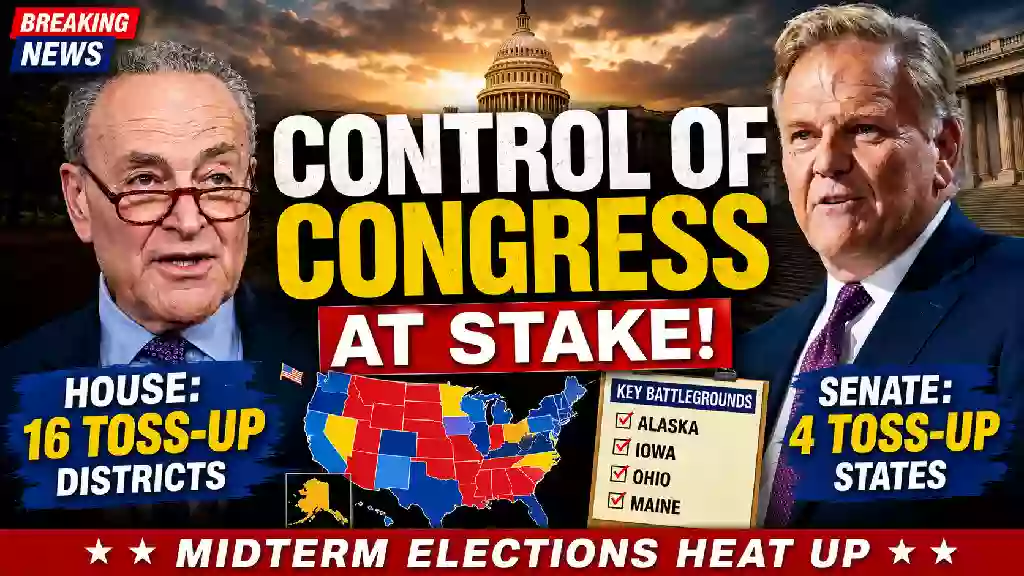
A YouTube thumbnail illustrating the battle for control of Congress during the 2026 U.S. midterm elections, featuring Chuck Schumer and political commentator Bill Hames alongside the U.S. Capitol and key House and Senate battleground races.
Control of Congress at Stake as Key Battleground Races Shape Midterm Election Outlook
2026 US Midterm Elections: House and Senate Battlegrounds Could Decide Control of Congress
As the race for control of Congress moves into its decisive stage, political analysts are closely monitoring a limited number of competitive House and Senate contests that could determine which party holds power after the upcoming U.S. midterm elections. With economic concerns, voter turnout, and campaign organization dominating the political landscape, both Democrats and Republicans are intensifying their efforts in key battleground states.
During a recent televised political discussion, analysts from across the political spectrum examined the latest congressional outlook, identifying the races most likely to shape the balance of power in Washington. While the parties disagree on what issues will ultimately sway voters, there is broad agreement that a relatively small number of competitive contests will decide the election.
House Race Remains Highly Competitive
According to projections discussed during the panel, Democrats currently maintain a slight advantage in the race for the House of Representatives. However, analysts emphasized that roughly 16 House districts remain genuine toss-up contests, making them the primary focus of campaign resources during the final months before Election Day.
These competitive districts are expected to receive increased attention through advertising, fundraising, candidate appearances, and voter outreach. Political observers noted that campaigns often become significantly more competitive after the 100-day mark, when undecided voters begin paying closer attention to national and local races.
Senate Control May Come Down to Four Key States
The outlook for the Senate remains equally uncertain. Analysts identified Alaska, Iowa, Ohio, and Maine as the four principal Senate toss-up races that could determine which party secures the majority. While each state presents unique political dynamics, all are expected to attract substantial campaign investment and national attention throughout the remainder of the election season.
The discussion also highlighted the challenges facing Democrats, who must defend several competitive seats while attempting to flip Republican-held states. Republicans, meanwhile, are working to maintain their existing seats while capitalizing on voter concerns surrounding the economy.
Analysts Offer Different Views on Democratic Strategy
One of the central topics during the discussion was whether the Democratic Party’s progressive candidates could influence the outcome in competitive races.
Conservative analyst Colin Reed argued that some candidates associated with more progressive political positions may find it difficult to win over moderate voters in swing states. He suggested that candidate selection in places such as Maine could become an important factor in the Senate battle.
Political commentator Richard Fowler offered a different assessment, arguing that economic issues are likely to have a greater impact on voter decisions than ideological debates. He said many voters may ultimately focus on inflation, gasoline prices, and household costs rather than internal divisions within either political party.
Grassroots Campaigns Could Influence Close Elections
Beyond television advertising and fundraising, campaign organization is expected to play a major role in several battleground states.
Fowler pointed to Michigan as an example of expanding grassroots activity, noting that labor organizations representing teachers and healthcare workers have increased their membership and volunteer base over the past year. According to the discussion, those organizing efforts could strengthen voter turnout operations in one of the country’s most competitive political battlegrounds.
Political strategists from both parties generally agree that volunteer networks, door-to-door canvassing, and voter mobilization efforts often prove decisive in elections decided by narrow margins.
Michigan and Texas Remain States to Watch
Michigan continues to be viewed as one of the most competitive Senate battlegrounds following several closely contested statewide elections in recent years. Analysts noted that Republicans see the state as one of their strongest opportunities to gain a Senate seat if current political trends continue.
Texas remains another closely watched state, although analysts acknowledged that Democrats continue to face an uphill battle after Republicans maintained a long record of statewide victories. Even so, the state remains part of the broader national conversation as both parties evaluate future electoral opportunities.
Polling and Candidate Performance Remain in Focus
The discussion also examined recent generic congressional ballot polling, which showed Democrats maintaining an advantage, although by a narrower margin than earlier in the campaign.
When asked whether Democratic Socialist candidates could become a political liability, Senate Democratic Leader Chuck Schumer dismissed the concern, expressing confidence in the party’s candidates and predicting Democrats would regain the Senate majority. Other panelists argued that campaign quality, candidate performance, and turnout efforts could ultimately matter more than national polling alone.
Economic Concerns Continue to Shape the Campaign
Although analysts differed on the political impact of ideology, there was broad agreement that economic issues remain among voters’ top priorities heading into the election.
Inflation, rising living costs, gasoline prices, and overall economic conditions continue to dominate campaign messaging from both parties as they compete for independent and undecided voters. Those issues are expected to remain central themes throughout the remainder of the campaign.
With control of both the House and Senate potentially depending on only a handful of competitive races, the coming months are expected to feature intensified campaigning, increased voter outreach, and closely watched contests across several battleground states as Americans prepare to cast their ballots.
#MidtermElections #Congress #USPolitics #HouseElections #SenateRaces #Election2026 #BattlegroundStates #PoliticalNews #Democrats #Republicans