Keane: U.S. Actions Could Put Iran’s Regime on a “Pathway to Collapse”
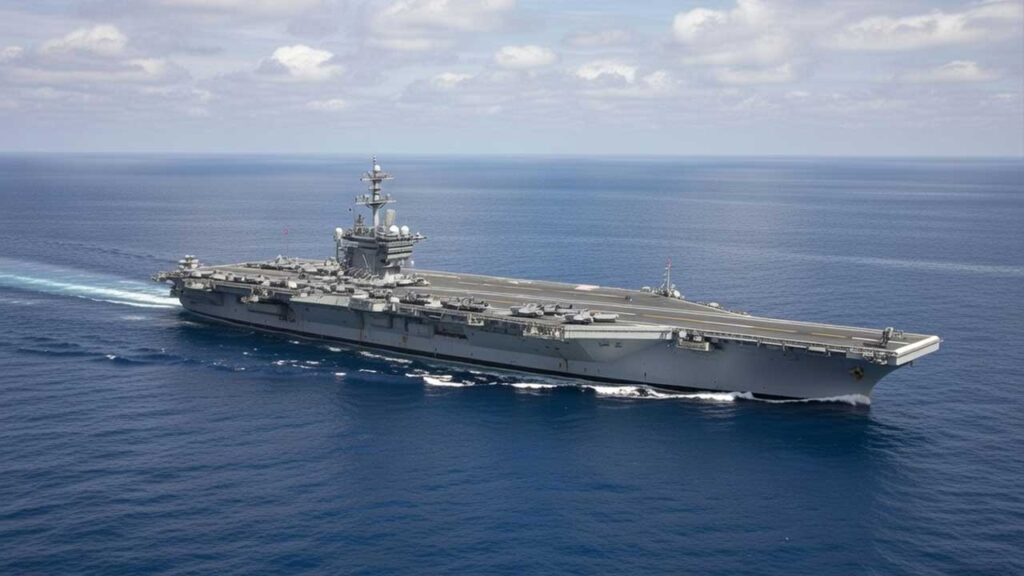
USS Abraham Lincoln deployment
Keane: U.S. Actions Could Put Iran’s Regime on a “Pathway to Collapse”
As anti-government protests in Iran intensify—and reports emerge that thousands of demonstrators may have been killed—the United States is repositioning military assets and escalating diplomatic pressure, signaling that a decisive moment may be approaching in the long-running standoff with Tehran. Retired four-star General Jack Keane says the current strategy is not necessarily about immediate regime change, but about placing Iran’s ruling structure on what he describes as a “pathway to collapse.”
Retired General Keane emphasizes that the U.S. actions could put Iran’s regime on a “pathway to collapse,” highlighting the critical nature of the situation.
The developments come as Donald Trump weighs potential next steps, including military options, amid growing international concern over the Iranian regime’s violent crackdown on its own people.
U.S. Military Assets Move Into Position
According to military sources, the U.S. is deploying additional forces to the Middle East, including at least one aircraft carrier. Reports indicate that the USS Abraham Lincoln may be among the assets repositioned, though officials have not confirmed whether it will come from the South China Sea or from recent departures out of Norfolk or San Diego.
These moves are widely viewed as both a deterrent and a signal that Washington is preparing a range of options should the situation in Iran deteriorate further.
White House correspondent updates also indicate that intelligence and diplomatic activity is accelerating behind the scenes, with global “chess pieces,” as one official described it, shifting rapidly.
High-Level Intelligence and Diplomatic Talks Underway
Adding to the gravity of the moment, Axios reports that the head of Israel’s intelligence service, Mossad, traveled to Washington for discussions with U.S. officials, including White House envoy Steve Witkoff. At the same time, Senator Lindsey Graham announced plans to travel to Israel, urging decisive action.
“This is not a distraction,” Graham said publicly. “People are being slaughtered in the streets.”
He described the moment as the most significant opportunity for change in Iran since the fall of the Berlin Wall—language that underscores how seriously some U.S. leaders view the current unrest.
Sanctions, Signals, and Strategic Pressure
While the White House has not publicly confirmed military action, pressure is mounting. The U.S. Treasury Department recently announced new sanctions against five Iranian officials, reinforcing economic pressure on a regime already weakened by years of sanctions, inflation, and internal dissent.
General Keane emphasized that these measures alone are not decisive—but they are critical enablers.
“We’re trying to squeeze Iran’s ability to sell oil,” Keane explained. “That’s not decisive in itself, but it contributes to weakening the regime.”
Covert Operations and Cyber Capabilities
Beyond visible military movements, Keane outlined a range of less-visible actions that may already be underway. These include covert efforts to help protesters communicate after Iranian authorities shut down the internet, as well as cyber operations targeting the regime’s command-and-control systems.
According to Keane, U.S. cyber capabilities are unmatched.
“Cyber operations against their communications, surveillance systems, and internal security networks are all tools the United States has,” he said. “Our offensive cyber capability is second to nobody.”
Such operations could disrupt the Iranian Revolutionary Guard Corps (IRGC) and Basij militia, which have reportedly been central to suppressing protests—often violently.
Information Warfare and Internal Fracturing
Keane also highlighted the importance of information operations aimed at sowing division within Iran’s security apparatus. The goal, he said, is to weaken loyalty among mid-level commanders and rank-and-file enforcers.
“If kinetic operations occur, we want that organization to fracture,” Keane said. “We want some of them to go over to the side of the protesters.”
This approach reflects a broader strategy of undermining the regime from within rather than attempting an immediate, externally imposed regime change.
Managing the Risk of Retaliation
Any escalation carries risks. Keane stressed that Iranian retaliation—against U.S. bases or Israel—must be anticipated and mitigated.
“That’s always part of the portfolio,” he said. “You have to consider what Iran will do in response and reduce their ability to retaliate.”
That could include expanding target sets to degrade Iran’s missile capabilities and bolstering regional defenses.
A Regime Already at Its Weakest Point
Despite warnings that military action would not guarantee collapse, Keane rejected the idea that U.S. leaders expect instant regime change.
“The objective has never been immediate collapse,” he said. “At best, we put the regime on a pathway to collapse.”
He noted that Iran is already politically, economically, and militarily weaker than at any point in the last 45 years. Arrests reportedly exceed 18,400, with at least 2,600 people killed—figures that underscore both the scale of unrest and the brutality of the response.
“The Best Opportunity in Decades”
Keane concluded by calling the current moment the most promising opportunity for change since 1979—stronger than the protests of 2009, 2019, or 2022.
“The people understand how weak the regime is,” he said. “That’s why they keep coming out, even at great personal risk.”
President Trump has stated publicly that those responsible for killing civilians will be held accountable. Keane says he takes that promise seriously.
“This is a huge opportunity,” he said. “And it’s one we haven’t seen before.”
#IranProtests #USForeignPolicy #MiddleEastCrisis #RegimeAccountability #GlobalSecurity
Retired Army Colonel Explains Putin’s Strategy as Ukraine War Drags On