The Freeze That Stopped Housing: What OHFA’s March 2026 Decision Means for Rural Oklahoma
okc-freeze.jpg
The Freeze That Stopped Housing: What OHFA’s March 2026 Decision Means for Rural Oklahoma
Introduction: A Sudden Halt to a Critical Housing Program
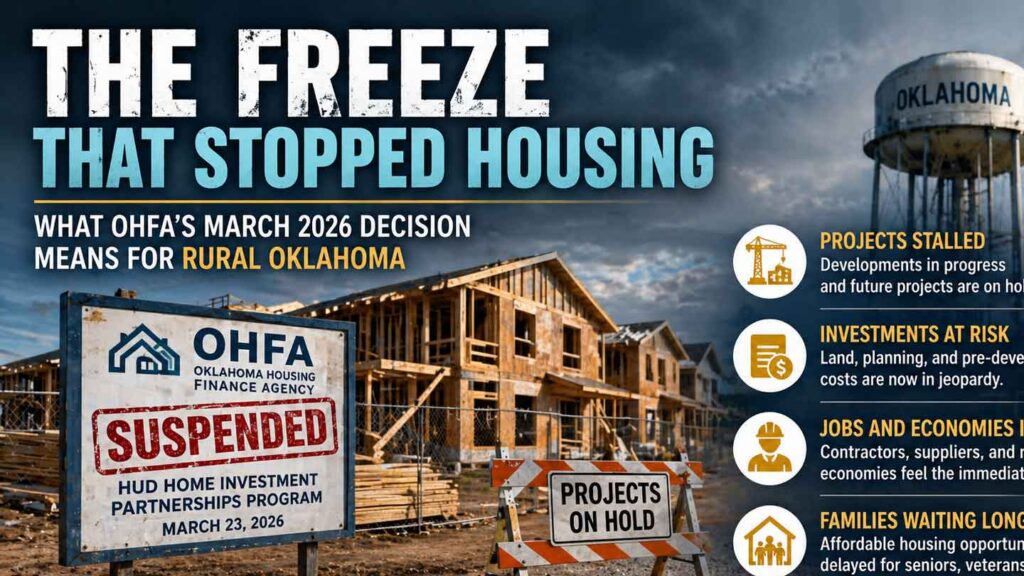
On March 23, 2026, the Oklahoma Housing Finance Agency (OHFA) Board of Trustees voted in a Special Board Meeting to suspend OHFA’s administration of the HUD HOME Investment Partnerships Program. The decision halted the acceptance of new applications and paused the review of projects that had not yet reached final agreement, pending the outcome of state legislation. While the Board Resolution does not specifically mention items like the Environmental Review process, staff interprets the Resolution to include a free on Environmental Reviews as well.
While framed in discussion at the OHFA Special Meeting as a temporary and precautionary measure, the reality is a permanent suspension until further Board action is taken. A review of the Formal Board Resolution reveals there is no mention of the word “temporary” in the entire Resolution. In fact, open records reveals that Resolution 26-03-09 not only calls for the suspense of the program – it eludes to the possible termination of the program.
The HOME program functions as a central funding source for affordable housing development across Oklahoma, and a suspension in administration of this federal funding source has immediate, real-world implications for projects, communities, and local economies.
Projects Placed on Hold
The most direct impact of the suspension is on housing developments currently in progress or in pre-development stages. According to reporting following the March meeting, the pause applies not only to future applications but also to projects already submitted that lack finalized agreements.
This creates a situation where projects that had been moving forward—often after months of planning, underwriting, and local coordination—are now effectively stalled. In some cases, developments awarded funding in late 2025 or early 2026 are unable to proceed, leaving financing structures unresolved and timelines uncertain. This includes developments approved at the November 2025 OHFA Board Meeting that cover Jackson, Pottawatomie, Logan, Canadian and Oklahoma Counties (See HOME Exhibit A). The January 2026 Board Meeting had approved developments in Okmulgee, Canadian and Oklahoma counties.
Housing development is highly time-sensitive. Delays can affect everything from construction schedules to financing commitments, particularly when multiple funding sources are layered together.
Land and Pre-Development Investments at Risk
Before construction begins, many projects require significant upfront investment. Nonprofit organizations secure land, conduct environmental reviews, and complete architectural and engineering work in anticipation of executing Written Agreements on their previously approved funding.
When funding is paused, these pre-development investments remain tied up. Land that was acquired for housing may sit unused, and project sites that were expected to transition quickly into construction may remain idle for an indefinite period. All work can also be lost if landowners will not grant extensions to closing – meaning these nonprofits across the state of wasted hundreds of staff hours and tens of thousands of dollars after moving forward in good faith.
This introduces financial uncertainty for organizations that must carry these costs without a clear timeline for when—or if—projects will resume.
Effects on Contractors and Local Economies
The HOME program is not only a housing initiative; it is also an economic driver. Over time, it has supported construction activity, job creation, and local investment across the state. For every dollar invested, the program has historically generated additional economic activity through related industries such as construction, materials supply, and professional services. According to the HOME Coalition – this program has supported over 25,500 jobs in the state and generated $1.6 billion in local income.
With the suspension in place, that economic activity came to an abrupt halt.
Contractors who were preparing to begin work now face gaps in their project pipelines. Subcontractors and suppliers—many of whom operate at the local level—may experience reduced demand. In smaller communities, where construction opportunities are more limited, even a small number of delayed projects can have a noticeable impact.
The pause also affects workforce continuity. Construction projects often rely on consistent scheduling to maintain crews and manage costs. Interruptions can lead to delays in hiring or retaining skilled labor.
Delays for Families Seeking Housing
Perhaps the most immediate and visible impact is on the individuals and families who rely on HOME-funded housing. The program supports a range of activities, including new construction, rehabilitation, and down payment assistance for low-income households.
When projects are delayed, so too are housing opportunities. According to OHFA’s own Oklahoma Housing Needs Assessment – Oklahoma needs 170,515 housing units by 2035 for both homeownership and rental. The National Low Income Housing Coalition The Gap Report data shows 43% of households that earn 80% of the Area Median Income (AMI) or less in Oklahoma are either cost burdened or severely cost burdened.
Now our seniors, veterans and families will face longer wait times. In markets where affordable housing supply is already limited, even short-term delays can have meaningful consequences.
A Contrast in Development Momentum
In recent years, communities across Oklahoma have pursued projects aimed at expanding affordable housing options. For example, initiatives in areas like Capitol Hill in Oklahoma City have demonstrated how coordinated investment can bring new homes online for income-qualified buyers, contributing to neighborhood revitalization and housing access. This development is a prime example of using HOME funds for affordable homeownership units.
These developments typically rely on federal HOME funding. With this funding stream paused, the ability to replicate similar projects becomes impossible.
Consistent program administration plays a critical role in housing development by Oklahoma’s Community Housing Development Organizations (CHDOs). Where funding is available and predictable, projects move forward. Where it is uncertain or paused, development slows or stops. For OHFA’s 2025 and 2026 awards – we are now stopped. OHFA received $8.3M from HUD in 2025 and takes 10% off that amount as administration fees. According to the Housing Assistance Council, 2026 funding will be at the same level.
Broader Statewide Implications
The March 23rd decision reflects a broader intersection of policy, funding, and program administration. The suspension is tied to pending legislation and concerns about how future requirements may affect program operations.
At the same time, the practical effects are already being felt across the state, with active projects placed on hold, planned developments delayed or reconsidered, local economic activity slowed, and housing availability timelines extended.
These impacts are particularly pronounced in rural areas, where access to alternative funding sources may be limited and where HOME funds often play a critical role in making projects viable.
The suspension of HOME program activities by OHFA represents more than an administrative pause. It interrupts a development pipeline that connects funding decisions to tangible outcomes—homes built, jobs created, and families housed.
Conclusion: Policy Decisions with Real-World Consequences
As discussions continue around the program’s future, the effects of the March 2026 decision illustrate how changes at the policy level translate into on-the-ground consequences. For rural communities across Oklahoma, the question is not only how the program will evolve, but how long development activity can remain paused before those impacts become more permanent. This begs other questions such as how does OHFA purport to be serving their mission of “providing housing resources with an eagerness to serve” by retroactively applying pending legislation to previous awards?
#AffordableHousing #OHFA #HousingCrisis #RuralOklahoma #HousingPolicy #HUDHOME #CommunityDevelopment #OklahomaNews #HousingFunding #RealEstateDevelopment
The Oklahoma Gun Laws That Most Residents Will Get Wrong in 2026