US Expands Air Campaign Against IRGC Logistics Near Strait of Hormuz as Regional Tensions Rise
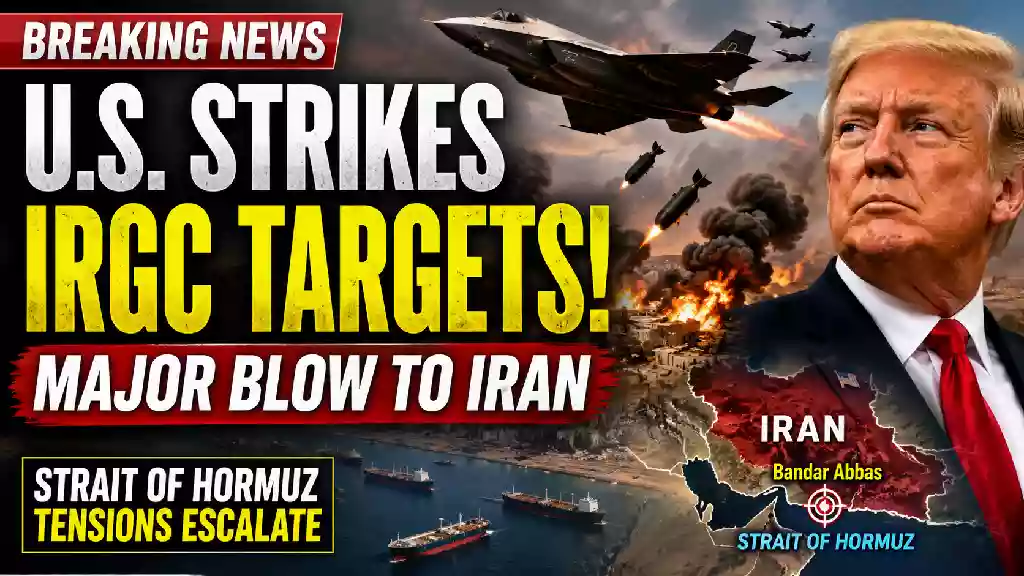
A YouTube news thumbnail illustrating the latest U.S. military airstrikes on IRGC targets near Bandar Abbas, Iran. The image features President Donald Trump, fighter jets, explosions, commercial ships in the Strait of Hormuz, and a map highlighting the strategic region amid escalating Middle East tensions.
US Expands Air Campaign Against IRGC Logistics Near Strait of Hormuz as Regional Tensions Rise
US Targets IRGC Supply Routes Near Strait of Hormuz Escalating Pressure on Iran
The United States has expanded its military campaign against Iran by launching coordinated airstrikes on infrastructure linked to the Islamic Revolutionary Guard Corps (IRGC) around the strategic port city of Bandar Abbas. According to U.S. officials, the operation targeted bridges, roads, military facilities, and logistics routes used to support Iranian military activities near the Strait of Hormuz, one of the world’s most important maritime trade corridors.
The latest strikes represent a significant escalation in Washington’s effort to deter attacks on commercial shipping while increasing pressure on Tehran to return to diplomatic negotiations.
Strategic Targets Around Bandar Abbas
U.S. Central Command (CENTCOM) focused its latest operation on transportation infrastructure surrounding Bandar Abbas, a major Iranian naval and military hub located along the Strait of Hormuz. Officials said the objective was to disrupt IRGC supply lines and reduce Iran’s ability to move military equipment, personnel, and weapons throughout the region.
The Strait of Hormuz remains a critical global shipping route through which a substantial share of the world’s oil exports passes each day. U.S. officials argue that protecting freedom of navigation through the waterway remains a central objective of the ongoing military campaign.
White House Defends Military Operation
The Trump administration said the strikes were carried out after Iran allegedly violated previous understandings intended to prevent attacks on commercial vessels operating in the Strait of Hormuz.
White House Press Secretary Caroline Leavitt said the recent military action was a direct response to continued attacks on international shipping. Administration officials also reiterated President Donald Trump’s position that Iran must not be allowed to threaten maritime commerce or advance its nuclear ambitions.
Officials maintained that while diplomatic communication with Tehran remains open, further attacks on commercial shipping could trigger additional military responses.
Iran Responds as Regional Security Concerns Grow
Following the U.S. operation, Iranian retaliation reportedly included missile and drone attacks targeting locations in Qatar, Bahrain, and Jordan, according to U.S. officials cited in the report. Iranian state media also reported damage to energy infrastructure near Bandar Abbas and said authorities had urged residents to reduce electricity consumption while repairs are underway.
No independent casualty figures were immediately available, and the full extent of the damage on either side has not been publicly confirmed.
The exchange of military strikes has heightened concerns that the conflict could spread beyond Iran, drawing additional countries into the growing regional crisis.
Global Shipping and Oil Markets Under Pressure
The escalating conflict has renewed concerns about the security of commercial shipping through the Strait of Hormuz. Maritime insurers and shipping companies continue to closely monitor developments as military operations increase across the region.
Energy analysts warn that prolonged instability along the waterway could disrupt global oil supplies and place upward pressure on fuel prices worldwide. Restoring confidence among commercial shipping operators will likely be essential to stabilizing international energy markets.
Houthi Threats Add New Dimension to Conflict
U.S. officials also warned that Iranian-backed Houthi forces in Yemen could attempt to expand the conflict by targeting shipping routes through the Red Sea. Such a move would threaten another vital international trade corridor and increase risks for global commerce.
Security experts have long viewed Iran’s regional proxy groups—including the Houthis, Hezbollah, and Hamas—as key components of Tehran’s broader strategic influence across the Middle East. Any coordinated response involving these groups could further complicate efforts to de-escalate the conflict.
Outlook
The latest military operation highlights the increasingly volatile relationship between the United States and Iran. While U.S. officials describe the campaign as a necessary effort to protect commercial shipping and regional stability, the continued exchange of military actions raises concerns about the potential for a broader regional conflict.
As diplomatic efforts continue alongside military operations, international attention remains focused on the Strait of Hormuz, where developments could have significant implications for global security, energy markets, and international trade.
#Iran #USMilitary #IRGC #StraitOfHormuz #BandarAbbas #MiddleEast #CENTCOM #BreakingNews #GlobalSecurity #MaritimeSecurity